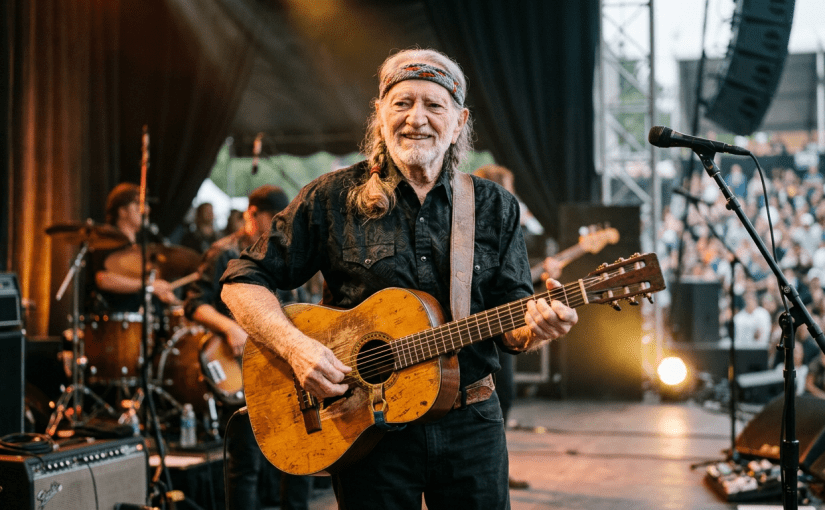
There are country music legends, and then there is Willie Nelson.
Nelson has shaped the genre of country music in ways few others ever could. With his unmistakable braids, weathered guitar, called ‘Trigger’, and a career spanning more than six decades, he isn’t just an artist; he is an institution!
Born in 1933 in Abbott, Texas, Willie Nelson grew up surrounded by music. Raised by his grandparents during the Great Depression, he was introduced early to the sounds of gospel and traditional country.
Church hymns and small-town radio became Nelson’s first teachers, and by the age of seven, he was already writing his own songs. Music wasn’t just a hobby, it was a way of understanding the world around him.
But Nelson’s journey to success was anything but straightforward. In his early years, he worked a variety of jobs in radio, and as a door-to-door salesman, while playing gigs wherever he could. He eventually made his way to Nashville, where his songwriting began to attract attention. However, the polished and formula-driven ‘Nashville sound’ didn’t suit his style.
Ironically, some of Willie Nelson’s earliest successes came through other artists. His song ‘Crazy’, famously recorded by Patsy Cline, became one of the most iconic ballads in county music history.
Nelson’s early songs showcased his remarkable ability to write lyrics that were simple yet deeply emotional; songs that resonated with everyday people navigating love, heartbreak and longing.
Despite his success as a songwriter, Willie Nelson struggled to find his own voice as a performer within Nashville’s strict expectations. Producers often tried to mold him into something that he wasn’t, smoothing out the very qualities that made him unique. Frustrated by the limitations, he made a bold decision in the early 1970s to leave Nashville and return to Texas.
The move back to Texas proved transformative. He found creative freedom and a community of like-minded artists who were equally disillusioned with the mainstream industry. Alongside people such as Waylon Jennings, Nelson became a pioneer of the ‘outlaw country’ movement, which rejected the polished sound in favour of raw, honest storytelling.
The spirit of that outlaw movement truly came alive on stage during collaborative concerts featuring Nelson, Waylon Jennings, Kris Kristofferson and Johnny Cash. These performances weren’t just concerts, they were gatherings of kindred spirits who had each carved their own path through the music industry. Audiences were treated to a rare chemistry, as each artist brought their own style, voice and storytelling prowess, yet blended seamlessly into a shared identity rooted in authenticity and rebellion.
Often performing together under the banner later popularised as The Highwaymen, these shows carried an energy that felt both intimate and monumental. There was a sense that something special was happening in real time; four legends trading verses, sharing stories, and celebrating the freedom they had fought for. Whether it was harmonizing on classic songs or delivering solo performances backed by mutual respect, these concerts captured the essence of outlaw country: independence, camaraderie, and a deep connection to the audience.
Nelson commented about the Highwaymen: “I think it’s one of the best things that’s ever really happened to me, to be able to work with these guys, because these are not only friends of mine, these are heroes.”
But back to Willie Nelson. Albums like Red Headed Stranger (1975) marked a turning point in his career. Stripped down and unconventional, it defied industry expectations, yet became a massive success. It told a cohesive story, blending sparse instrumentation with emotional depth, a risk that paid off in redefining what country albums could be. Nelson commented: “Red Headed Stranger was my chance to make the album exactly the way I heard it.”
A few years later, Stardust (1978) showcased his versatility, featuring interpretations of pop and jazz standards that further blurred genre boundaries. Speaking about the material he chose for the album, Nelson said: “I picked my ten favourite songs from my childhood.”
What makes Willie Nelson truly unique is his refusal to be confined by labels. While he is undeniably a country artist, his music incorporates elements of jazz, blues, folk and even swing. His vocal style is instantly recognizable; relaxed and slightly behind the beat. Rather than adhering to technical perfection, Nelson prioritises feeling, delivering performances that sound intimate and authentic.
At the heart of his sound is his guitar, which he named after Roy Roger’s horse, Trigger! Worn and weathered from decades of use, with a hole carved into its body from years of strumming, the guitar tells its own story. Together, Nelson and Trigger create a sound that is as distinctive as it is timeless.
Beyond music, Nelson has also made a lasting impact through his activism and cultural influence. In 1985, he co-founded Farm Aid, an organisation dedicated to supporting American farmers. The annual concerts have raised millions of dollars and brought attention to the struggles faced by rural communities.
One of the most remarkable aspects of Willie Nelson’s career is his longevity. While many artists fade over time, he continues to record new music and perform well into his later years. His voice, though aged, still carries depth and richness. Each note he sings feels lived-in, and each lyric sounds as though it presents a sense of wisdom and experience.
Nelson’s influence can be heard in countless artists who have followed in his footsteps. From outlaw country to modern Americana, his legacy is woven into the fabric of the genre. He showed that it is possible to succeed without compromising artistic integrity. Authenticity can resonate more powerfully than perfection!
In the end, Willie Nelson’s legacy isn’t just measured in awards, chart positions or album sales. It is found in the stories that he has told, the boundaries he has pushed, and the lives he has touched through his music. He didn’t just follow the road; he paved his own, inviting others to do the same.
And perhaps the most enduring lesson of all is that artistry isn’t always about fitting in – it is about standing apart, staying true, and letting your voice be heard, no matter how unconventional it may be.
By Norman Thomson
Discover more from NGT Music
Subscribe to get the latest posts sent to your email.

 NGT Music